Obomei's 6 Steps to Organizational Flow
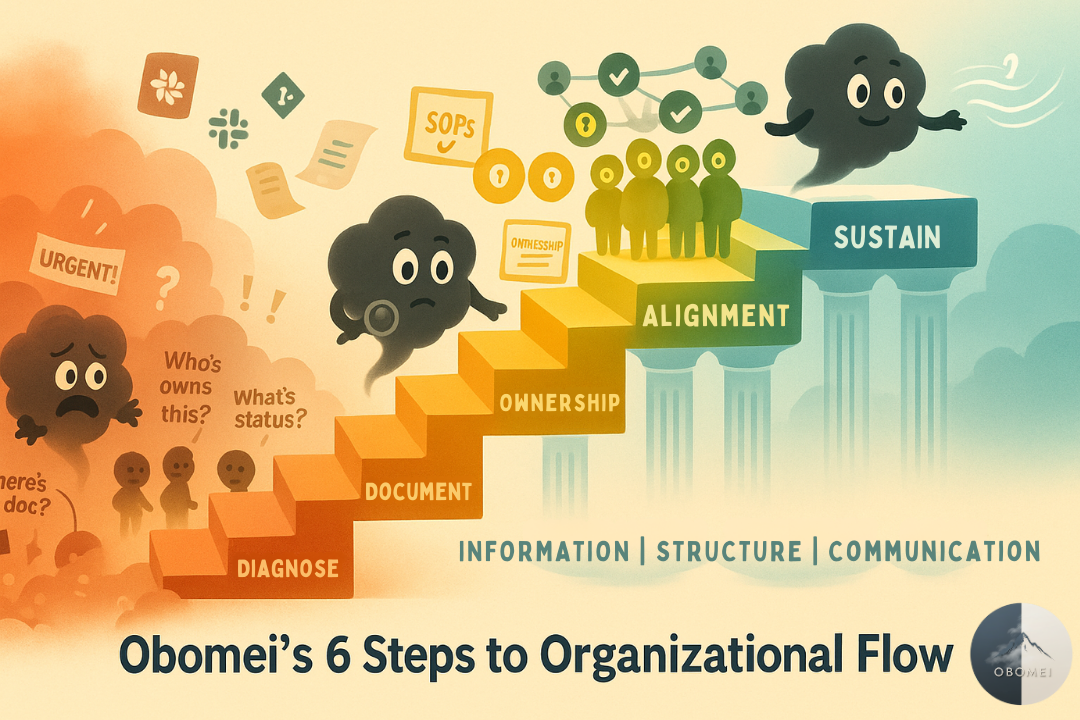
Visual showing Chaos Clouds ascend to Organizational Flow
The pattern repeats across every growing company. Work piles up, everyone stays late, deadlines slip. The instinct says hire more people, add new tools, push harder. So you do. Three months later, the new person still asks where to find things, work still falls through cracks, and you're managing even more chaos with a bigger payroll. What works at 5 people breaks at 15. What works at 15 collapses at 50. The problem isn't capacity or effort, it's that operational systems haven't evolved with the team.
Most leaders treat this as separate problems: slow onboarding, unclear ownership, misalignment, coordination breakdowns. But these are symptoms of one underlying gap. When Information is scattered, Structure is unclear, and Communication breaks down, adding resources just multiplies the confusion. Growing teams need a systems evolution that builds infrastructure before the cracks become crises.
Phase 1: Diagnose the Real Bottleneck
Your team is overwhelmed. Everything feels urgent, nothing gets finished, and the obvious solution seems to be more capacity. But research from operations management reveals something counterintuitive: when you have too many things in progress simultaneously, everything slows down even when everyone is busy. Studies on work-in-progress limits show that reducing concurrent tasks can increase throughput by 30-40% (Anderson, 2010). This traces back to Little's Law, which proves that throughput depends on how many items you're juggling and how long each one takes to complete.
The diagnostic starts by mapping your flow. Track how work moves from intake to delivery. The queues reveal your real bottleneck, which is usually not headcount. Work gets stuck because no one knows who owns it, where to find the brief, or what "done" actually means. Some work arrives in waves. Some tasks take 2 hours, others take 20. That variability kills flow faster than understaffing ever could.
If your flow is chaotic, your priorities unclear, and your work-in-progress (=WIP) count unlimited, adding people won't fix it. You'll just have more people drowning in the same broken system. The signal that you actually need capacity comes when your flow is stable and predictable, yet capacity stays saturated across several cycles. The bottleneck is a specialized, repetitive task that's already optimized. Queues stay high even after you've reduced variability. Until then, you're solving the wrong problem.
Phase 2: Build a Knowledge Foundation
Once you've confirmed the system can handle more capacity, the next test arrives faster than most leaders expect. Your new hire starts Monday. Three weeks later, they're still shadowing colleagues, digging through old docs, asking the same questions everyone asks, trying to decode unwritten rules. If you can't onboard someone without live human involvement, your systems aren't documented well enough to scale.
Research on organizational knowledge transfer shows that when critical processes exist only in people's heads, new hires face what researchers call "knowledge loss" (Argote & Ingram, 2000). Every time someone joins, you're rebuilding their understanding from scratch through expensive, inconsistent shadowing. The symptoms appear everywhere. "Just watch Sarah do it" becomes the standard training protocol. SOPs scatter across Google Drive. Workflows hide in Slack threads. Tool access lives in someone's email. That "centralized" wiki hasn't been updated since 2022.
The gap isn't just processes. If your existing team doesn't have clear completion criteria, new hires can't know when they've actually finished something. Tasks linger at "90% complete" forever because "done" was never defined. This same infrastructure issue that slows onboarding also prevents effective AI implementation. You can't train an agent on knowledge that only exists in people's heads.
Phase 3: Assign Clear Ownership
Documentation solves the knowledge problem. New hires can find what they need. But work still falls through cracks. Deadlines still slip. When you ask "who's handling this?" you get silence. Most teams confuse activity with ownership. Activity means "I worked on that." Ownership means "I'm responsible for that outcome."
Research on organizational accountability confirms that diffusion of responsibility is real, with teams showing 25% lower task completion rates when ownership is unclear (Frink & Klimoski, 2004). Recent studies on psychological ownership in teams demonstrate that clearly assigned accountability increases both task performance and organizational citizenship behaviors (Pierce & Jussila, 2010). When everyone is responsible, no one is responsible. The clearest signal of a team that's busy but not growing appears in tasks without owners, meetings without decision-makers, and projects where "the team" is accountable but no single person can tell you the current status, blockers, or next steps.
The practice that changes this requires assigning ONE progress owner for every meaningful task or decision. Not a committee. Not "the team." One person who can tell you the current status without checking with others, owns the next action even if they're not doing the work themselves, and reports progress on a predictable rhythm. This becomes how every other operational practice actually works. Meetings move things forward only when someone owns each decision. Systems create alignment only when owners update them. Delegation works only when delegated work has a clear owner.
Regular progress check-ins aren't micromanagement in this context. They're accountability infrastructure. When you ask owners for updates on a predictable rhythm, you're not checking up on them. You're giving them a structure to stay on track and flag problems before they become crises.
Phase 4: Create Automatic Alignment
Clear owners solve the accountability gap. Sarah owns the product roadmap. James owns customer onboarding. But half your team still pushes one direction, half pushes another. Everyone's working hard, just not together. The instinct says schedule an alignment meeting. But alignment isn't a one-off meeting. It's what happens when teams have both Content and Context.
Misalignment isn't intentional. It's structural. People work blind when they don't know what others are doing, why decisions were made, or where to find current information. They're operating without Content (clear owners who can answer "what's the status?") or Context (a single source of truth). Research on team effectiveness shows that when information scatters across multiple tools, people look at different versions of reality (Mathieu et al., 2000). Jira for tickets, Slack for status, SharePoint for files, Notion for docs, Excel for "this one thing." When everyone's looking at different information, alignment breaks even when people want it to work.
The diagnostic for misalignment asks two questions. Can someone immediately tell you the status without hunting for it? If not, you have an ownership problem. Can everyone find current information without asking around? If not, you have an accessibility problem. When you have clear owners updating a single source of truth, alignment stops being a meeting topic. It becomes automatic. Trust emerges not from team-building exercises but from reliable information flow. When teams know who owns what and where to find updates, they stop second-guessing and start moving.
Phase 5: Scale Before Breaking
Your system is humming now. Documentation is solid. Ownership is clear. Alignment is automatic. You're at 8 people. A quick Slack message solves most problems. Everyone knows what everyone's working on. You don't need much process because you have alignment through proximity.
Fast forward 18 months. You're at 25 people. That same Slack message now creates confusion. "Wait, who decided this?" Half the team didn't see it. The other half interpreted it differently. What felt agile now feels chaotic. Research on organizational growth shows that communication overhead increases exponentially with team size, with coordination costs rising faster than linear growth would predict (Aral & Van Alstyne, 2011). At 5 people, you have 10 communication paths. At 15 people you have 105 paths. At 50 you have over 1,200. Modern studies confirm that teams above 15 members experience significant drops in coordination effectiveness without explicit knowledge management systems (Cummings & Haas, 2012).
The systems that break first reveal the pattern. Verbal updates replace documentation because "Just ask Sarah" works when Sarah sits next to you and has time. At 20+ people, Sarah can't be the single source of truth and she shouldn't have to be. Alignment happens through osmosis when everyone overhears everything and context spreads naturally. Once you hit 15+ people or go hybrid, osmosis stops working and people operate in information silos without realizing it. Quick decisions feel faster than documentation early on, so moving fast means skipping the write-up. But each undocumented decision becomes tribal knowledge that new people can't access. At scale, this compounds into expensive onboarding delays.
The shift most teams wait too long to make involves systematizing early, not when it hurts but when it's still manageable. Basic documentation from Day 1. Clear decision logs. One source of truth for project status. These feel like overhead at 5 people. They're survival infrastructure at 25.
Phase 6: Distinguish Work Types
You've built the systems. Documentation is solid, ownership is clear, alignment is automatic, and your infrastructure scales with headcount. But something still feels off. Small tasks keep getting postponed. Weekly planning happens some weeks, not others. The reflection ritual you set up died after two months. You're managing tasks, routines, and habits in the wrong systems.
Taking out the trash. Your morning reflection. That 15-minute item on your list for three weeks, moving from Monday to "maybe next week." We treat tasks, routines, and habits like they're the same and wonder why our productivity systems break. James Clear's Atomic Habits (2018) says lower the threshold. But what about activities that are easy yet you postpone endlessly? The problem isn't difficulty. You're managing them in the wrong system.
Research shows successful habits become "invisible" to conscious task management (Wood & Neal, 2007). Between "new behavior" and "automatic habit," routines get stuck in limbo. Tasks are part of projects with clear outcomes and deadlines. "Draft Q4 budget" needs tracking, an owner, and a completion date. These belong in your project management system. Routines are behaviors you're making habitual. "Weekly reflection" or "morning planning" aren't automatic yet. Still conscious. Still need activation energy. These need activating triggers, not task lists. Calendar reminders. Habit stacking. Running shoes by the door. Take them off your to-do list. Habits are unconscious and automatic. Your morning coffee. Your evening run once ingrained. No task lists or trackers needed.
The trap comes from treating routines like tasks, where motivation fails, or tasks like routines, where you forget. Taking out trash needs a recurring reminder. Morning reflection becomes a habit when you stop treating it like a task to "complete."
From Six Phases to One System
These aren't six separate fixes. They're one operational system that evolves through necessary phases: diagnose whether you have a system problem or capacity problem, document your processes so knowledge doesn't live in people's heads, assign ownership so every outcome has a name attached, build alignment through content and context not endless meetings, scale proactively before your communication overhead explodes, and distinguish tasks from routines from habits so each gets the right system.
Most teams skip straight to hiring more people without building the infrastructure that makes growth sustainable. Then they wonder why new hires take months to ramp up, work still falls through cracks, and alignment gets harder not easier. At Obomei, this journey represents what we mean by turning chaos into clarity. When Information (documentation, accessible knowledge), Structure (clear ownership, scaling systems), and Communication (alignment infrastructure, decision logs) work together, people stop firefighting and enter a flow state.
The practical next steps break down by phase:
For Phase 1 diagnosis, map your current flow from intake to delivery. Identify where work piles up and sits waiting. Ask whether your flow is chaotic with unclear priorities and unlimited work-in-progress, or stable and predictable but still saturated.
For Phase 2 documentation, run the onboarding test by asking whether you could onboard someone with zero live meetings. Document your 10 most common recurring tasks as simple SOPs showing trigger, steps, and done. Create a short "How We Work" playbook covering tools, meetings, communication protocols, and decision-making. Centralize everything in one source of truth. Define completion criteria clearly.
For Phase 3 ownership, pull up your current project list. For each item, name one person who owns that outcome (not who's doing work on it, who owns it). If you can't answer immediately, you have a clarity problem that will become an accountability problem. Set up regular progress rhythms where owners update status on a predictable schedule.
For Phase 4 alignment, pick one project where alignment is shaky. Ask who owns the current status, where that status lives, and whether everyone can access it without asking. Fix those three things to watch coordination overhead drop. Build one centralized system that houses all current information rather than scattering it across six tools.
For Phase 5 scaling, pick your most common coordination pattern whether that's status updates, decision-making, or knowledge sharing. Ask whether this would still work if you doubled in size tomorrow. If you hesitated, that's your next system to build. Start systematizing now while it's manageable, not when it breaks.
For Phase 6 sustainability, audit your to-do list. Find three items you keep moving forward. Ask whether you're building them into habits or whether they're just recurring tasks. Move routines from task lists to calendar triggers. Use habit stacking to build triggers for behaviors you're still making automatic. Leave actual project tasks in your project management system with clear owners and deadlines.
The question isn't whether you're busy enough. It's whether your systems are designed to help you scale or just survive.
